At 82, I invited my elite, greedy children to dinner, introduced my new 60-year-old mechanic husband, and handed them a legally binding document stripping them of every single penny.
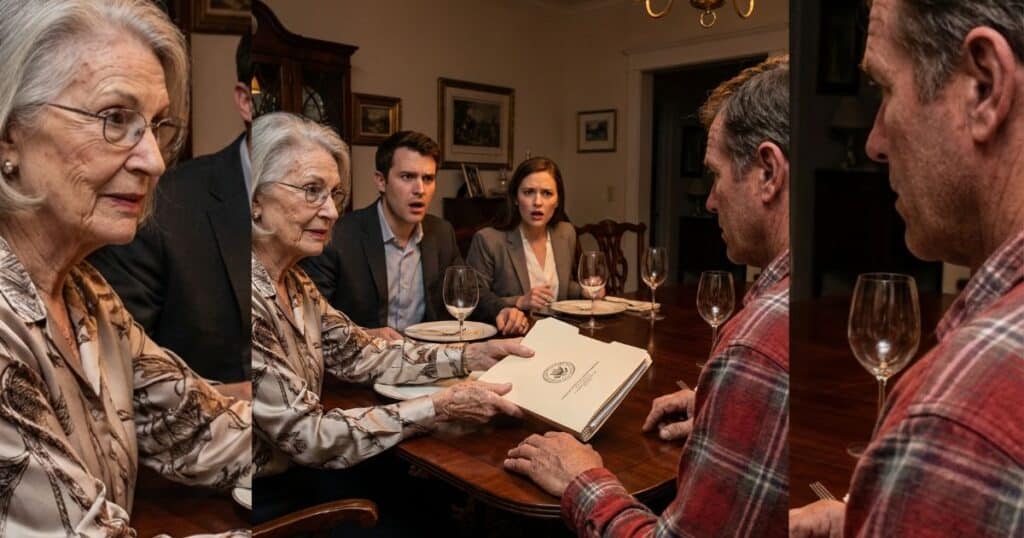
“What is the meaning of this, Mother?” Richard demanded, his face flushing a deep, dangerous crimson.
He gripped the edges of the heavy mahogany dining table so hard his knuckles turned white. Beside him, his sister Eleanor dropped her sterling silver fork. It clattered against her fine china plate, ringing out like an alarm bell in the vast, silent dining room of my estate.
“The meaning is exactly what it says on the paper, Richard,” I said. My voice was calm, steady, and devoid of the grandmotherly warmth they had exploited for decades.
I took a slow sip of my water. “You and Eleanor are no longer the beneficiaries of my estate. Everything—this house, the investment portfolios, the offshore accounts—belongs to Arthur.”
I gestured to the man sitting quietly to my right. Arthur was sixty years old. He wore a simple, neatly pressed flannel shirt and dark denim jeans.
He didn’t belong in this opulent room with its crystal chandeliers and velvet drapes. His hands, resting on the table, were rough and callused. The faint, permanent stains of motor oil were settled deep into the lines of his skin.
He was a retired mechanic. And as of yesterday afternoon at the county courthouse, he was my legally wedded husband.
“You’re out of your mind,” Eleanor hissed, finally finding her voice. She stood up, her designer silk blouse trembling as she pointed a manicured finger at Arthur. “Who are you? How did you get to her? Are you stalking her at the country club?”
“I don’t go to country clubs, ma’am,” Arthur replied softly. His voice was a deep, gravelly baritone. He didn’t look angry; he just looked tired.
“Don’t you speak to my sister!” Richard yelled, slamming his fist onto the table. The wine glasses shook. “Mother, this is textbook elder abuse! This man is a predator. He’s brainwashed you!”
I laughed. It was a dry, hollow sound that seemed to startle them both. For twenty years since their father died, they had known me only as the quiet, accommodating widow. They thought I was fragile. They thought I was merely a placeholder keeping their inheritance warm.
“No one has brainwashed me, Richard,” I said, leaning forward. “For the first time in my miserable life, my mind is entirely my own.”
I tapped the thick manila envelope sitting in front of him. “I suggest you take that to your lawyers. You’ll find the paperwork is airtight. Now, both of you, get out of my house.”
The silence that followed was deafening. Richard stared at me, his mouth slightly open, processing the absolute authority in my tone. Eleanor burst into tears, though I knew her well enough to recognize the tears were for the loss of her millions, not the loss of her mother.
“This isn’t over,” Richard snarled, grabbing his coat from the back of the chair. “We will drag you into court. We will have you declared mentally incompetent. And you,” he spat, glaring at Arthur, “I will see you locked in a federal prison.”
They stormed out. The heavy oak front door slammed shut with a force that rattled the windows.
The sprawling, empty house was suddenly very quiet. I let out a long, shuddering breath and leaned back in my chair, pressing my fingers to my aching temples.
Arthur reached over and gently placed his rough hand over mine. There was nothing romantic in the gesture. There was no late-life, sweeping passion between us. It was a touch of profound, shared exhaustion.
“Are you sure you want to go through with this, Beatrice?” Arthur asked quietly. “They’re going to tear you apart. They’re going to dig up every piece of dirt they can find.”
“Let them dig,” I whispered, staring blindly at the grand portrait of my late husband, Thomas, that hung over the fireplace. “I’ve been buried under his dirt for forty years. It’s time the earth was turned.”
The war began exactly four days later.
My children did not hesitate. They hired one of the most ruthless, high-end litigation firms in the city. The kind of lawyers who wore five-thousand-dollar suits and billed by the minute to destroy families.
A process server arrived at my front porch, handing me a thick stack of legal documents. Richard and Eleanor were filing an emergency injunction to freeze all my assets.
Worse, they were petitioning the state to grant them full medical and financial conservatorship over me. They claimed I was suffering from severe, undiagnosed dementia. They claimed Arthur was a con artist who had isolated me in my home, preyed upon my loneliness, and forced me into a fraudulent marriage.
“They’re playing dirty,” my own attorney, a trusted old friend named Harrison, told me over the phone. “They’ve hired private investigators to look into Arthur’s background. They are preparing a narrative that he targets wealthy widows in 55-plus communities.”
“Let them weave whatever stories they want,” I told Harrison. “Just set the deposition. I want it on the record. I want them all in the same room.”
Harrison sighed. “Beatrice, a deposition is a grueling process. They will attack your character. They will try to confuse you and make you look incompetent on camera. Are you physically up for this?”
“I have never been more ready for anything in my entire life,” I said, and hung up.
The following weeks were a humiliating circus. I was forced by court order to undergo intense psychiatric and cognitive evaluations.
Neurologists asked me to count backward from one hundred by sevens. Psychologists asked me to draw clock faces and remember strings of random words. They prodded my memory, searching for any crack, any sign of cognitive decay.
I passed every single test flawlessly. My mind was as sharp as cut glass.
Arthur, meanwhile, bore the brunt of their harassment with a quiet, stoic dignity. Private investigators parked across the street from my estate, taking photos of him watering the hydrangeas on the front porch.
They dug through his credit history. They found out he had lived in a modest trailer park for the last ten years. They found out he had once filed for bankruptcy. To my children, this was the ultimate proof of his guilt. To them, poverty was a character flaw.
Our late-night conversations became my only sanctuary. We would sit on the back patio, listening to the crickets, drinking decaffeinated tea.
“My sister would have loved this garden,” Arthur said one evening, looking out over the moonlit rose bushes.
“She deserved a garden like this,” I replied softly, my heart aching with a guilt that had festered inside me for decades. “She deserved so much more.”
“You don’t have to carry the weight of it anymore, Beatrice,” he told me.
“I have to carry it until the ink is dry on the judge’s order,” I said fiercely. “I have to see this through.”
The day of the deposition arrived with a heavy, suffocating humidity.
The law firm was located on the fiftieth floor of a towering glass skyscraper downtown. The conference room was sterile and cold, smelling faintly of ozone and expensive floor wax.
A videographer set up a camera at the end of a long, polished granite table. Richard and Eleanor sat on the opposite side, flanked by their attorneys.
Richard looked unbearably smug. He wore a custom-tailored navy suit, his arms crossed over his chest. Eleanor refused to even look at me; she stared at her phone, radiating furious entitlement.
Their lead counsel was a man named Vance. He had sharp, predatory eyes and a smile that never quite reached them. He started with Arthur.
For two agonizing hours, Vance grilled Arthur. He weaponized every detail of Arthur’s working-class life.
“Mr. Hayes,” Vance sneered, pacing behind his clients. “Isn’t it true you’ve lived below the poverty line for the last twelve years?”
“I lived within my means,” Arthur answered calmly.
“Isn’t it true you met my clients’ mother purely by chance at a local hardware store? And within three months, you had convinced her to marry you?”
“We met at the hardware store, yes,” Arthur said. “But I didn’t convince her of anything. The marriage was her idea.”
Richard scoffed loudly. Vance smirked, turning to the videographer to ensure the reaction was captured.
“Her idea,” Vance repeated mockingly. “A woman of eighty-two suddenly decides to marry a destitute mechanic and hand over a thirty-million-dollar empire. Very plausible, Mr. Hayes. Very believable.”
Then, Vance turned his sights on me. He walked over and leaned across the table, invading my personal space. He spoke to me in a slow, loud, patronizing tone, the way one might speak to a confused toddler.
“Beatrice, sweetheart,” Vance began, his breath smelling of stale coffee. “Do you really understand the magnitude of what you’ve signed? Do you understand that this man is taking away your children’s future?”
I looked at Vance. Then I looked past him, locking eyes with Richard and Eleanor.
The simmering heat in my chest, a fire I had kept banked for forty years, finally broke free.
“Do not speak to me like I am a child, Mr. Vance,” I said. My voice echoed off the glass walls, sharp as a whip.
Vance blinked, stepping back slightly.
“I understand exactly what I have done,” I continued, sitting perfectly straight. “I am of sound mind, and I am fully aware of every penny in my accounts. I know the exact routing numbers of my trusts. I know the market value of the estate.”
I turned my gaze entirely to my children. They both shifted uncomfortably under my stare.
“You brought us here to uncover a fraud,” I said to my son and daughter. “You brought us here to prove that I am being manipulated. Well, you are going to get exactly what you asked for. The truth.”
I took a deep breath. The camera was recording every word. There was no going back.
“You both worship your late father,” I began. “You look at his portrait and see a titan of industry. A self-made man who built an empire from the ground up to provide for his family.”
Richard frowned. “Leave Dad out of this. He has nothing to do with your delusions.”
“He has everything to do with this!” I snapped. “Your father did not build his empire, Richard. He stole it. He pillaged it from people who actually worked for a living.”
Eleanor rolled her eyes. “Mother, please, not this bleeding-heart nonsense again.”
“Quiet!” I commanded, slamming my hand on the granite table. Eleanor flinched.
“In 1984,” I said, my voice dropping to a dangerous, steady rhythm, “your father targeted a mid-sized, family-owned manufacturing plant in the next county over. It was a thriving business. It employed three hundred local men and women. It was owned by a man named David Hayes.”
Arthur closed his eyes, his jaw tightening.
Vance looked confused, flipping through his notes. “I fail to see the relevance of a business transaction from forty years ago—”
“You will listen!” I fired back. “Your father didn’t just buy that company. He executed a hostile, predatory takeover. He found a legal loophole in their pension fund. He deliberately tanked the company’s stock, forced them into receivership, and then bought the assets for pennies on the dollar.”
I looked at Richard, forcing him to meet my eyes. “He didn’t just bankrupt the company, Richard. He personally ruined the family. He sued them for breach of contract on a technicality. He drained their personal savings.”
I felt the tears prick my eyes, but I refused to let them fall.
“David Hayes suffered a massive stroke from the stress,” I continued, my voice trembling with the weight of the memory. “His wife needed round-the-clock care they could no longer afford. David’s younger sister, Margaret, stepped in. She sold her own home. She emptied her retirement accounts to pay their medical bills and fight your father’s endless lawsuits.”
The room was completely silent now. The arrogant smirk had vanished from Richard’s face.
“Margaret came to our house one night,” I whispered. “It was raining. She stood on our front porch, begging your father for mercy. Begging him to drop the personal lawsuits so she could afford her brother’s medication. I stood in the hallway and watched. Your father laughed in her face and shut the door.”
Eleanor was staring at me, her face completely pale.
“Six months later, the Hayes family was destitute,” I said. “David died. His wife died shortly after. And Margaret… Margaret’s spirit was entirely shattered. The stress, the poverty, the absolute cruelty of what had been done to her… it stopped her heart. She died in a rundown apartment, utterly alone, destroyed by the wealth you two now feel so entitled to.”
I turned slowly to my left and looked at the quiet man sitting beside me.
“Arthur’s last name isn’t Smith,” I said. The words fell into the room like heavy stones. “His full legal name is Arthur Hayes. He is Margaret’s much younger brother.”
Vance dropped his pen. It clattered loudly on the granite table.
Richard stared at Arthur, his mouth working, but no sound coming out. Eleanor pressed both her hands over her mouth, her eyes wide with horror.
“This marriage is not a romance,” I stated, looking directly into the camera lens. “It is not a delusion. It is a legally binding, completely intentional act of restitution.”
I turned back to my children.
“I tried for years to give the money back,” I confessed. “But your father locked everything in trusts that I couldn’t touch without his approval. When he died, he left the estate structured in a way that ensured I could only pass it down to his bloodline. If I simply wrote a will leaving it to Arthur, or to a charity, you two would tie it up in probate court for a decade until Arthur was dead.”
I smiled, a fierce, triumphant smile.
“My lawyers informed me there was only one legal entity that supersedes a contested will. A spouse. By marrying Arthur, the assets transfer to him entirely outside of probate. It is an ironclad, impenetrable fortress.”
I leaned back in my chair, suddenly feeling incredibly light. The crushing burden I had carried in my chest for four decades was finally gone.
“I am returning the wealth to the family that rightfully earned it,” I told my children. “I am washing the blood off my hands. You are stripped of your inheritance because it was never truly yours to begin with. It was stolen.”
I looked at Vance, who was staring at me with a mixture of shock and professional defeat.
“So, Mr. Vance,” I said. “Are there any further questions regarding my mental competence?”
There were no more questions.
The deposition ended abruptly. Vance frantically ushered my children into a private side room. Through the glass walls, I could see Richard pacing frantically, yelling at the lawyer. I could see Eleanor sitting in a chair, weeping uncontrollably.
They weren’t just mourning the money anymore. They were mourning the myth of their father. They were burdened, finally, with the dark, ugly truth of their legacy.
They had to face the reality that their luxury cars, their private schools, and their sprawling estates were paid for by the suffering of innocent people.
Arthur and I took the elevator down to the lobby in silence. We walked out into the warm afternoon sun.
“Thank you,” Arthur said softly, as we waited for our car.
“You don’t owe me any thanks, Arthur,” I replied. “This was a debt forty years past due.”
Two days later, the lawsuit was entirely dropped.
Vance’s law firm formally withdrew their petition for conservatorship. The injunction on my assets was lifted. My children realized that if they took this to a public trial, the media would feast on the scandal of their father’s predatory history. Their social standing, their precious reputations at the country club, would be completely annihilated.
They chose to walk away. They slinked back into the shadows, forced for the first time in their lives to build their own futures without the safety net of ill-gotten wealth. I have not spoken to them since.
Arthur moved his few belongings into the estate. We did not live as husband and wife. We lived as two survivors who had finally found peace at the end of a long, bitter war.
He spent his days restoring the old greenhouse in the backyard, his hands working the soil, bringing life back to a property that had been steeped in greed for so long.
I spent my days sitting on the front porch. For the first time in my life, I could look out over the manicured lawns and the sprawling oak trees and feel absolutely nothing but peace. The ghosts that had haunted the hallways of my home were finally gone.
Three weeks later, I sat in my favorite wicker armchair as the sun began to set, painting the suburban sky in brilliant shades of orange and gold.
I listened to the distant sound of Arthur humming a quiet tune as he watered the garden. I closed my eyes, feeling the gentle evening breeze against my face.
The restitution was complete. The scales were balanced. My conscience, at long last, was completely clear.
And as the last rays of sunlight faded from the porch, I finally let go, drifting into a deep, endless, and perfectly peaceful sleep.
Thank you so much for reading this story!
I’d really love to hear your comments and thoughts about this story — your feedback is truly valuable and helps us a lot.
Please leave a comment and share this Facebook post to support the author. Every reaction and review makes a big difference!
This story is a work of fiction created for entertainment and inspirational purposes. While it may draw on real-world themes, all characters, names, and events are imagined. Any resemblance to actual people or situations is purely coincidenta