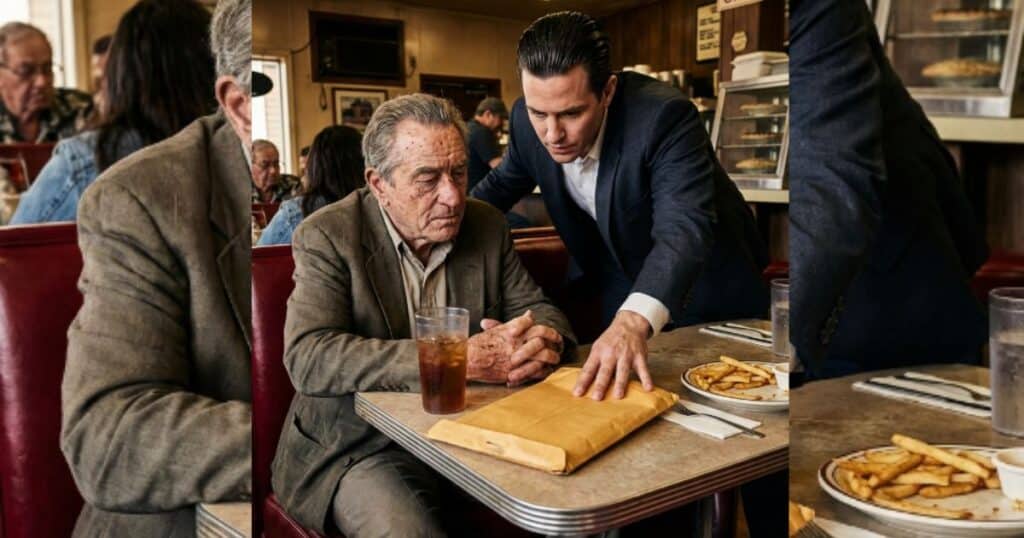
My son shoved the legal papers across the diner table, demanding control of my life, all because the woman I loved fifty years ago just moved in down the hall.
“Sign it, Dad. It’s for your own good.”
Robert’s voice was as cold as the iced tea sweating on the sticky vinyl table between us.
He didn’t look like a son worried about his father’s failing mind. He looked like a corporate shark closing a hostile takeover.
“I’m not signing over my Power of Attorney, Robert,” I said. My hands shook slightly, a betrayal of my seventy-five years, but my voice was rock steady. “There is absolutely nothing wrong with my head.”
“You’re seventy-five, Dad. You’re acting like a reckless teenager.” Robert leaned forward, lowering his voice so the waitress wiping down the counter wouldn’t hear. “You’ve known this woman for three weeks!”
“I’ve known her for fifty-two years,” I corrected him softly, feeling a sudden, sharp ache in my chest.
Robert scoffed, rolling his eyes as if I were a toddler throwing a tantrum over a toy.
“A high school fling,” Robert sneered. “Now she magically shows up at your retirement community, and suddenly you’re talking about buying a quarter-million-dollar motorhome? It’s textbook dementia, Dad. Or worse, elder financial abuse. She’s after the estate.”
He thumped his manicured finger against the thick, terrifying manila envelope.
“The emergency petition is already filed with the county clerk,” he warned. “A judge is going to look at your erratic behavior and hand me the reins anyway. Do this the easy way. Let me protect your assets.”
I looked at the boy I had raised, feeling a profound, crushing sense of failure.
He wore a tailored suit that cost more than my first two cars combined. His eyes were entirely focused on the bottom line. My bank accounts, my property portfolio, his future legacy.
He didn’t care about my sudden spark of happiness. He only cared about his inheritance.
It had all started on a perfectly mundane Tuesday at the Oakwood Terrace Assisted Living Community.
I was sitting in the central courtyard, reading a battered paperback, waiting for the afternoon sun to dip behind the old oak trees. It was the same routine I had followed for two years since my wife passed. Wake up, eat bland oatmeal, read, wait for the day to end.
Then, the automatic double glass doors slid open.
A new resident was being given the standard tour by the facility director.
Her hair was a striking, elegant silver now, not the vibrant, fiery auburn it used to be. She used a polished wooden cane to steady her left leg as she walked.
But the way she tilted her chin? The way her sharp green eyes scanned the courtyard with that familiar, defiant spark?
It was Eleanor.
My breath caught in my throat so hard I started to cough. I legitimately thought I was having a cardiac event.
Fifty years of life, of marriage, of career, of raising a family, all vanished in a single, thunderous heartbeat.
She turned her head at the sound of my coughing. Our eyes met across the manicured lawn.
She stopped dead in her tracks. The facility director kept talking, pointing toward the dining hall, completely oblivious to the earthquake happening ten feet behind him.
“Arthur?” she whispered. I couldn’t hear it over the distance, but I could read her lips.
I stood up from my bench so fast my joints screamed in protest. I walked toward her, feeling like a ghost haunting my own life.
We sat on a wrought-iron bench in the garden until the sun went down. We talked through the awful, unseasoned dining room dinner. We talked in the recreation room until the night nurses gently told us it was past visiting hours.
Back in 1974, we were completely inseparable. We were going to conquer the world together.
But we were young, totally broke, and utterly terrified when she got pregnant.
My father was a stern, wealthy, unforgiving man who controlled every aspect of my life. When I confessed the situation, he threatened to disown me immediately. Eleanor’s family was deeply conservative. The scandal of an unwed pregnancy would have ruined them in our small town.
We made a heartbreaking, cowardly choice. Or rather, I let my overbearing father make it for us.
He handed me an envelope stuffed with crisp hundred-dollar bills. I drove to Eleanor’s house, handed her the envelope, and cried in my car. I told her I loved her, but we couldn’t do this. I told her to go to the city and get the procedure.
I was too much of a coward to go with her. I never saw her again.
The guilt of that envelope ate at me for decades. It hovered like a dark cloud over my eventual, practical marriage to Robert’s mother. It sat in the corner of the room during every forced family holiday.
Now, half a century later, here she was. Widowed, just like me, moving into an apartment three doors down from mine.
“I forgave you a long time ago, Arthur,” she told me on our third consecutive evening together, sitting on the sprawling front porch of the main building.
The summer air was thick with the smell of jasmine and old regrets.
“I never forgave myself,” I admitted, staring down at my heavily lined, liver-spotted hands. “I abandoned you when you needed me most.”
“We were terrified kids,” she said softly, reaching out to cover my trembling hand with her warm one. “We did what we thought we had to do to survive.”
That simple physical touch changed my entire cellular structure. It felt like waking up from a fifty-year, dreamless coma.
Suddenly, I didn’t want to sit in a beige recliner and wait for the grim reaper. I didn’t want to play bingo or eat pureed carrots. I wanted to live. I wanted to make up for lost time.
The very next morning, I called a local luxury dealership and asked for brochures on premium recreational vehicles. Then, I called my bank to inquire about liquidating a portion of my mutual funds.
That was my fatal mistake.
Robert, who had himself listed as an emergency contact on all my financial accounts “just in case,” got an automated alert about the inquiry.
He was over at Oakwood Terrace before lunch.
He barged into my small, one-bedroom apartment without knocking, his face flushed a dark, angry red.
“Who the hell is she?” he demanded, bypassing any form of greeting.
“Her name is Eleanor. She’s an old friend,” I said, calmly putting down my coffee mug on the small kitchenette counter.
“An old friend who suddenly has you trying to liquidate hundreds of thousands of dollars? Have you completely lost your mind?”
“It’s my money, Robert,” I said, standing up to face him. “I earned it working forty years at the firm. I saved it. And I will spend it how I see fit.”
“That money is the foundation of the family trust, Dad! It’s supposed to be protected!”
“Protected for who? You?” I asked, my temper finally flaring. “You have a massive salary, Robert. You live in a gated community. You drive a European sports car.”
“It’s the principle of the thing!” he shouted, pacing the small room like a caged animal. “You are vulnerable! This facility is full of predators. This woman is a professional gold digger. I’m going to speak to the director and have her evicted.”
He didn’t stop there.
He hired a private investigator to look into Eleanor’s background. He used his connections at the local bank to temporarily freeze the joint checking account we shared for “medical emergencies.”
And then came the terrifying paperwork.
A greasy-haired process server cornered me in the facility lobby, shoving a clipboard into my chest.
It was the Emergency Petition for Conservatorship and Power of Attorney.
The legal jargon was thick and confusing, but the underlying message was crystal clear: Arthur is rapidly losing his mental faculties. He is being financially exploited by a new resident. He needs to be stripped of his civil rights for his own protection.
I was devastated. Not just angry, but profoundly, soul-crushingly broken.
My own flesh and blood was willing to declare me legally incompetent just to safeguard his future bank balance. He was willing to strip away my dignity so he wouldn’t lose a dime.
When I brought the legal papers to Eleanor’s apartment later that night, she didn’t look scared. She didn’t look intimidated.
She looked absolutely furious.
“He actually thinks he can just erase your autonomy?” she asked, her voice tight, gripping the arms of her chair.
“He thinks I’m a senile old fool being conned,” I said, rubbing my temples, a migraine building behind my eyes. “The mediation hearing is set for Thursday. He’s bringing his high-priced corporate lawyer. They’re going to use the RV inquiry and my refusal to take a memory test to prove I’m manic.”
Eleanor went completely quiet. She stared out her small window at the darkening courtyard, her jaw set in a hard line.
“Arthur,” she finally said, not turning around. “There’s something I need to tell you.”
“What is it?” I asked, suddenly feeling a new wave of anxiety.
“Not yet,” she said, turning back to me with a look of pure steel in her green eyes. “I need to make a few phone calls. Let him bring his expensive lawyer on Thursday. Let him bring his bottomless arrogance.”
“Eleanor, please, what are you planning?”
She smiled. It wasn’t a sweet, grandmotherly smile. It was the fierce, defiant, terrifying smile of the teenage girl I fell in love with half a century ago.
“I’m going to show your greedy son exactly what a family legacy actually looks like.”
The mediation room was located in a sleek, glass-paneled law office in the center of the city.
It smelled of expensive roasted coffee, leather bindings, and intimidation.
Robert sat across from me at the massive oak table, flanked by a lawyer who looked younger than my son but wore a suit sharp enough to cut glass. Robert refused to make eye contact with me, staring instead at his legal pad.
I sat alone. The mediator, a neutral, professionally dressed woman with kind eyes but a firm, no-nonsense voice, sat at the head of the table.
“We are here to discuss the emergency petition regarding Arthur’s competency, and the proposed transfer of his estate management,” the mediator began, folding her hands.
Robert’s lawyer immediately took the floor, aggressive and polished.
“My client is acting purely out of deep familial love and concern,” the lawyer lied smoothly, his tone entirely transactional. “Arthur has recently exhibited highly erratic, dangerous behavior. Reconnecting with a woman he hasn’t seen in over five decades, attempting massive, uncharacteristic financial withdrawals…”
“I wanted to buy a camper,” I interrupted, gripping the edge of the table.
“A luxury motorcoach,” the lawyer corrected without missing a beat. “Costing nearly two hundred and fifty thousand dollars. This sudden, massive impulsivity is a hallmark symptom of severe cognitive decline. We have sworn affidavits from his previous doctor suggesting…”
The heavy wooden door to the conference room clicked and swung open.
Every head in the room turned.
Eleanor stood in the doorway. She was wearing a tailored navy pantsuit, leaning slightly on her cane, and holding a thick leather binder against her chest.
Standing right behind her was a tall, broad-shouldered man who looked to be in his late forties. He had salt-and-pepper hair, wearing a simple gray suit, radiating a quiet, solid presence.
My breath caught in my throat. I couldn’t tear my eyes away from him.
The man had my eyes. He had my jawline. He had the exact same stubborn cowlick in his hair that I had fought with every morning of my youth.
“Excuse me,” Robert snapped, jumping up from his leather chair. “This is a closed, legally confidential mediation. You absolutely cannot be in here.”
Eleanor ignored him entirely. She walked straight into the room, her cane tapping a steady, rhythmic march on the hardwood floor.
The tall man followed her, silently pulling out a chair for her right next to me, then standing firmly behind her like a bodyguard.
“I believe I have a very deeply vested interest in this family’s estate planning,” Eleanor said, her voice echoing clearly in the quiet room.
“You have no legal standing whatsoever,” Robert’s lawyer sneered, looking at her with open disgust. “You are merely a resident at his care facility. You are the reason we are here. I will call security.”
“Oh, I am much more than a resident,” Eleanor said softly.
She opened the leather binder.
She pulled out a yellowed, fragile piece of paper. It looked incredibly old, meticulously protected inside a rigid, clear plastic sleeve.
She slid it across the smooth expanse of the oak table directly toward the mediator.
“Fifty years ago, Arthur and I were in a very difficult, desperate situation,” Eleanor said to the room, though her eyes were fixed on the mediator. “Arthur’s wealthy father demanded I terminate my pregnancy. He provided a large envelope of cash to ensure it happened quietly.”
I looked down at my hands. The shame still burned hot in my chest, a fire that had never truly gone out.
“But I couldn’t do it,” Eleanor continued, her voice trembling just a fraction before steeling over.
The room went dead silent. The ticking of the wall clock sounded like a sledgehammer.
I whipped my head around to look at her. “Eleanor… what are you saying?”
“I took a bus to a different state,” she said, finally turning to look right into my watering eyes. “I moved in with my aunt. I told my strict parents I was attending a special secretarial school in the city. I never went to that clinic, Arthur.”
She pointed a shaking finger at the yellowed paper resting in front of the mediator.
The mediator slowly picked it up, adjusting her reading glasses.
“This is a certified Certificate of Live Birth,” the mediator read aloud, her professional composure slipping into genuine shock for a split second.
“Read the names for the record,” Eleanor instructed.
“Mother: Eleanor Davis,” the mediator read, tracing the faded ink. “Father: Arthur…”
She read my full, legal name. Middle name and all.
I felt all the blood rush out of my head. The room spun. I looked up at the tall man standing behind Eleanor.
He smiled at me. A hesitant, gentle, incredibly vulnerable smile.
“Hello, Arthur,” the man said. His voice was deep, resonant. “My name is David.”
I couldn’t breathe. I couldn’t form a single word. Fifty years. Fifty years of mourning a child that never existed, a sin I thought I committed, only to find out my son had been walking the earth this whole time.
I stood up slowly, my knees trembling so violently I thought I would collapse. David stepped forward instantly, catching my shoulders.
I reached out, grabbing his forearms. They were solid. They were real.
“You’re my son,” I whispered, hot tears finally breaking free and spilling down my wrinkled cheeks.
“I am,” David said, his own eyes shining with unshed tears. “Mom told me everything a few days ago. I had absolutely no idea. I thought my father died before I was born.”
“Wait. Stop! Stop this right now!” Robert’s shrill voice shattered the beautiful, fragile moment.
Robert was standing, his face pale as a ghost, his finger pointing wildly at David. “This is a scam! This is an elaborate, ridiculous con! You found a guy who looks like him to forge a document!”
“It is a legally verified, state-issued document,” Eleanor corrected him smoothly, not even raising her voice. “And we have already submitted DNA swabs to a private lab for expedited testing to satisfy any court inquiry. But look at him, Robert. Look at your father. You know it’s true.”
Robert looked. The lawyer looked.
The color drained completely from Robert’s face.
He saw the overwhelming biological resemblance. It was undeniable. It was written in their bone structure.
But Robert wasn’t having an emotional family revelation. He wasn’t happy he had a brother. He was doing terrifying math in his head.
“If he’s your son,” Robert stammered, looking at his expensive lawyer in a state of total, unadulterated panic. “If he’s a legitimate, biological child…”
“Then he is an equal heir under the law,” the mediator confirmed softly, setting the birth certificate down. “Unless a will specifically excludes him, which, if Arthur is declared incompetent today, cannot be legally altered.”
Robert slumped back into his heavy leather chair as if he had been physically struck by a baseball bat.
His precious, guarded inheritance. The estate he was trying to legally steal from me by declaring me mentally unfit. It had just been sliced perfectly, irrevocably in half.
But Eleanor wasn’t finished.
“Actually,” Eleanor said, calmly closing her leather binder. “Arthur’s estate isn’t going to be split in half at all.”
Robert’s head snapped up. A sickening flicker of hope ignited in his greedy eyes for a fraction of a second. Did she mean David didn’t want the money?
“What do you mean?” Robert asked, his voice cracking.
“I mean,” I said, my voice suddenly finding a booming strength I hadn’t felt in a decade, “that my cognitive faculties are perfectly intact. And I am entirely capable of making brand new legal arrangements right now.”
I looked at David. My son. My beautiful, unexpected, firstborn son.
“David, what do you do for a living?” I asked, wiping my eyes.
“I’m a certified public accountant, sir,” David said respectfully, standing tall. “I manage municipal pension funds and massive trust accounts for the city.”
I let out a loud, genuine, joyful laugh that echoed off the glass walls. The irony of the universe was exquisite.
I turned back to Robert. The boy who had tried to bury me alive.
“You tried to cage me, Robert,” I said, my voice dropping to a dangerous, icy whisper. “You tried to lock me away in a legal box so you could play king of the castle with my life’s work.”
Robert swallowed hard, looking at his lawyer for any kind of help. But the sharp-suited lawyer was already busily packing his briefcase, snapping the latches shut, realizing a lost war when he saw one.
“We are officially withdrawing the petition,” the lawyer muttered, standing up and refusing to look at Robert. “There is clearly no medical or legal case for cognitive decline here. Good day, gentlemen.”
“Smart man,” Eleanor noted, a smirk playing on her lips.
“Dad, wait, please, let’s talk about this rationally,” Robert pleaded, extending his shaking hands across the table.
“We’re done talking, Robert,” I said, turning my back on him. “You wanted to protect the estate? Fine. I’m going to protect it. From you.”
We left the downtown mediation office and drove straight to the county courthouse.
It wasn’t a romantic, candlelit affair. It was fiercely efficient.
We stood before a bored justice of the peace in a small, wood-paneled room, holding hands tightly.
David stood right beside me as my best man. A son I had known for exactly two hours, who already felt vastly more like family than the son I had raised under my own roof for forty years.
When the judge finally pronounced us husband and wife, I kissed Eleanor.
It tasted like second chances. It tasted like absolute, undeniable freedom.
The very next morning, we met with a brand new estate lawyer. A man highly recommended by David’s accounting firm.
We utilized a beautiful, complex, legally airtight maneuver.
I transferred every single asset I owned—the heavy investment portfolios, the commercial real estate, the massive savings accounts—into a newly formed Irrevocable Trust.
Once the assets were formally placed in the trust, they were no longer legally mine to manage or own. Which meant Robert could never, ever sue me for control of them again, no matter what happened to my health.
And who did I name as the sole, executing trustee of this massive fortune?
David.
My accountant son. A man of quiet, proven integrity who had made his own way in the world. He didn’t want my money, but he promised to protect it fiercely from anyone who did.
I left incredibly clear, undeniable instructions in the final trust document.
Robert was to receive a single, final, one-time payout from the estate upon my eventual death.
Ten thousand dollars.
Exactly enough to cover the retainer of the lawyer he had hired to try and ruin my life.
Not a single penny more.
Three days later, a massive, gleaming, state-of-the-art Class-A motorcoach pulled up to the circular driveway of Oakwood Terrace.
The air brakes hissed loudly, drawing the immediate attention of every single resident sitting on the sprawling front porch.
I walked out the automatic front doors, holding my wife’s hand.
I wasn’t using a cane. I didn’t feel the chronic ache in my lower back. I felt twenty-five years old again, ready to take on the entire world.
David was standing by the open door of the massive RV, holding the heavy set of keys. He gave me a tight, emotional hug.
“Call me the second you hit the Grand Canyon,” David said, patting my shoulder firmly.
“We will,” I promised, hugging him back fiercely. “Take care of the trust, son.”
“It’s locked down tighter than Fort Knox, Dad,” he smiled, stepping back. “Nobody is touching a single dime without my direct, written approval.”
I saw Robert’s silver luxury sedan squeal into the visitor parking lot just as I was helping Eleanor up the high metal steps of the motorhome.
Robert jumped out of his car, sprinting across the manicured, green lawn, his tie flapping in the wind.
“Dad! Dad, you can’t just leave! The house! The bank accounts! The new lawyer says I’m legally locked out of absolutely everything!”
I stood on the top step of the RV and looked down at him.
He looked so incredibly small. So utterly defeated by his own blinding, consuming greed.
“You should have just let me buy the camper, Robert,” I said.
I pulled the heavy, insulated door shut, sealing us inside our new world.
Eleanor was already sitting in the plush passenger seat, a massive paper road map spread across her lap. She looked up at me, her green eyes sparkling with a mischievous, youthful fire.
“Where to first, husband?” she asked, tracing a line across the map.
I slid into the comfortable driver’s seat, gripped the large leather steering wheel, and fired up the massive, rumbling diesel engine.
“Absolutely anywhere,” I said, putting the massive rig into gear. “We have fifty years to catch up on.”
The RV rolled smoothly down the long, winding driveway of the facility. I didn’t look back in the rearview mirror. I didn’t need to.
My past, my present, and my future was sitting right next to me, and for the first time in a very long time, the road ahead was wide open.
Thank you so much for reading this story!
I’d really love to hear your comments and thoughts about this story — your feedback is truly valuable and helps us a lot.
Please leave a comment and share this Facebook post to support the author. Every reaction and review makes a big difference!
This story is a work of fiction created for entertainment and inspirational purposes. While it may draw on real-world themes, all characters, names, and events are imagined. Any resemblance to actual people or situations is purely coincidenta