They thought I was just a frail, knitting widow they could easily bully out of my home, until I opened my files and destroyed their entire empire.
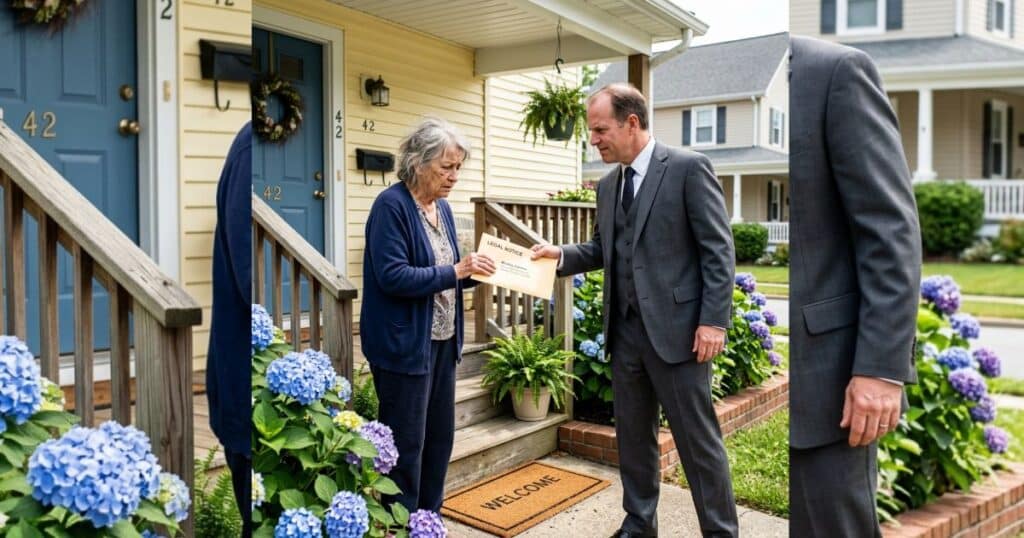
“Sign the notice, Clara. It’s a lien on the house. You have thirty days to vacate or repaint, and we both know on your fixed income, you can’t afford the painters.”
Richard Vance, the president of the Whispering Pines Homeowners Association, stood on my front porch with his arms crossed.
His shadow fell cold across the blooming hydrangeas my late husband, Arthur, had planted.
My hands trembled violently as I took the heavy, cream-colored envelope from his grasp.
“Richard, please,” I whispered, my voice sounding incredibly thin and brittle in the warm afternoon air. “It’s just a shade lighter than the approved beige. Arthur painted it this color before he passed. It’s Buttercream Yellow.”
Richard sighed, a harsh, condescending sound that echoed through the quiet suburban cul-de-sac.
“Rules are rules, Clara. We have a standard to maintain in this luxury community. The board has voted.”
He leaned in closer, his expensive cologne entirely suffocating the scent of my garden.
“Between you and me? You shouldn’t be living here alone anyway,” he said smoothly. “This house is too much for you. Let the lien go through. I know a real estate investor who will take this place off your hands for a fair price, as-is.”
My breath hitched in my throat.
He didn’t just want me to paint my home. He wanted me out.
Richard wanted to force a foreclosure, snap up my beautiful home for pennies on the dollar, and flip it for a massive profit.
“I won’t leave,” I stammered, clutching the envelope to my chest. “This is my home.”
Richard smiled, a tight, merciless pulling of his lips.
“We’ll see about that, Clara. Thirty days.”
He turned on his heel and marched down my driveway, getting into his pristine luxury sedan.
I stood on the porch, completely frozen, until his car disappeared around the corner of the manicured street.
When I finally walked back inside and locked my heavy wooden door, the silence of the empty house pressed down on me like a physical weight.
I collapsed into Arthur’s old leather recliner, the tears I had fought so hard to hold back finally spilling over my wrinkled cheeks.
I was seventy-eight years old. I had bad knees, a heart condition, and an absolutely terrifying fear of confrontation.
For the last five years, since Arthur passed, I had made myself as small and invisible as possible.
I baked cookies for the neighborhood block parties. I knitted baby blankets for the local hospital.
I nodded politely when Richard and his board of cronies issued ridiculous fines for leaving trash cans out five minutes too late.
But this? This was my sanctuary. Every corner of this house held a memory of my fifty-year marriage.
The thought of losing it to a greedy, tyrannical bully made my stomach twist into painful, sickening knots.
I sat in the dark living room for hours, staring at the terrifying legal notice resting on my coffee table.
I felt completely powerless. I felt utterly defeated.
And then, slowly, the deep, paralyzing grief began to morph into something else.
It started as a tiny spark in the center of my chest, a feeling I hadn’t experienced in over three decades.
It was a cold, sharp, and intensely focused anger.
Richard Vance thought he was dealing with a sweet, helpless grandmother who would just roll over and cry.
He didn’t know that before I moved to the suburbs to retire, before I embraced gardening and baking, I had another life.
In the 1980s, I wasn’t just Clara the widow.
I was Clara Higgins. And in the corporate boardrooms of the city, they called me “The Liquidator.”
I specialized in auditing failing corporations, dismantling corrupt executive boards, and finding every single hidden penny in their cooked books.
I wiped my tears away with the back of my hand. My trembling stopped completely.
I stood up, walked past my knitting basket, and headed straight for the spare bedroom.
Deep in the back of the closet, beneath boxes of old winter coats, sat a heavy cedar trunk locked with a brass padlock.
I found the key on my key-ring, my hands completely steady now.
The lock clicked open with a satisfying snap.
Inside, there were no photo albums or sentimental trinkets.
There were thick stacks of yellow legal pads, a vintage accounting calculator, heavy-rimmed reading glasses, and a stack of crisp, perfectly tailored blazers.
I pulled out a legal pad and my favorite heavy barrel pen.
“Alright, Richard,” I said to the empty room, my voice no longer a whisper, but a steady, authoritative baritone. “You want to play hardball over the neighborhood books? Let’s look at the books.”
The very next morning, I drove my sensible sedan to the Whispering Pines property management office.
The receptionist, a young woman who always looked completely terrified of her boss, blinked at me in surprise.
“Oh, Mrs. Higgins. Mr. Vance isn’t in today. Did you come to drop off the painting fine?”
“No, dear,” I said, offering her a sweet, grandmotherly smile. “I am here to submit a formal, written request for the complete financial ledgers of the Whispering Pines Homeowners Association for the past five fiscal years.”
The girl’s jaw practically hit the desk. “The… the ledgers?”
“Yes,” I continued, sliding a neatly typed, perfectly formatted legal request across the counter. “Under state civil code, as a dues-paying member of this cooperative community, I have the absolute right to audit all unredacted financial records, vendor contracts, and bank statements within forty-eight hours of a written request.”
She stared at the paper as if it were glowing.
“I… I have to ask Mr. Vance,” she stammered.
“You can ask whoever you like, dear,” I said, tapping the paper with a manicured fingernail. “But the forty-eight hour clock starts right now. If the boxes aren’t ready by Friday morning, I will be returning with a civil magistrate.”
I turned and walked out, my posture perfectly straight, feeling the old, familiar thrill of the hunt rushing through my veins.
When I returned on Friday, there were three massive cardboard boxes waiting for me in the lobby.
Richard wasn’t there, but the receptionist looked pale and incredibly nervous.
I loaded the boxes into my trunk and drove home, my mind already calculating, sorting, and analyzing.
I transformed my dining room table into a war room.
I pushed aside the floral centerpieces and laid out rows of highlighters, sticky notes, and a steaming pot of black coffee.
For the next four nights, I barely slept.
The house was completely silent, save for the rhythmic clacking of my calculator and the rustling of heavy paper.
At first glance, the HOA budget looked perfectly normal.
Richard was a clever man. He had masked the expenditures under layers of mundane, bureaucratic language.
But I had spent my entire career hunting clever men.
By the second night, my eyes burning from exhaustion, I found the first thread.
It was a line item for “Preventative Landscaping Maintenance” billed by a company called Apex Property Solutions.
The community was paying Apex forty-thousand dollars a quarter.
That was an astronomical sum for a neighborhood of our size. We only had a few common green spaces and a modest clubhouse garden.
I pulled the actual vendor invoices from the second box.
Apex was charging three hundred dollars an hour for basic lawn mowing, and billing for fifty hours of work a week.
It was completely absurd. It was blatant overbilling.
I grabbed my red pen and circled the name: Apex Property Solutions.
The next morning, I drove down to the county clerk’s office in the city center.
“I need to pull the business registration and articles of incorporation for an LLC,” I told the clerk.
Ten minutes later, I was staring at a microfiche screen, reading the founding documents for Apex Property Solutions.
The registered owner was a man named Gregory Miller.
The name sent a massive, electric shock straight down my spine.
Gregory Miller.
I had been to the neighborhood summer barbecue last year. I remembered Richard boasting loudly by the grill about his family.
He had introduced his daughter, Sarah, and her new husband.
Her husband, the ambitious entrepreneur. Gregory Miller.
The puzzle pieces snapped together with terrifying clarity.
Richard was the sole authorized signer for all HOA vendor contracts.
He had bypassed the community bidding process entirely.
He was legally funneling hundreds of thousands of dollars of our neighborhood’s collective reserve funds directly into his own son-in-law’s pocket.
And that wasn’t all.
I spent the next two days furiously digging deeper.
Once I knew the pattern, the entire fraudulent scheme unraveled in front of my eyes.
The roof repair company that charged triple the market rate? Owned by Gregory Miller’s college roommate.
The consulting firm hired to do our “annual neighborhood safety survey”? An LLC registered to Richard’s own private residential address.
Richard wasn’t just a petty tyrant obsessed with paint colors.
He was systematically bleeding the community’s emergency reserves absolutely dry.
If a major storm hit and we needed real repairs, the neighborhood would go entirely bankrupt.
I leaned back in my chair, staring at the massive web of red lines and sticky notes covering my dining room wall.
The sheer audacity of it was breathtaking.
He was threatening to take my house over a shade of yellow, while he was quietly robbing all of us blind.
The anger in my chest solidified into a cold, unbreakable resolve.
I couldn’t just expose him. I had to utterly dismantle him.
But to do that, I needed backup.
On Tuesday afternoon, I walked down to the local corner diner.
I knew that Mildred from down the street and Harold from the cul-de-sac met there every week for pie and coffee.
They were good people. Quiet people. People who had both been heavily fined and bullied by Richard’s aggressive regime.
I slid into the vinyl booth across from them.
Mildred looked up, surprised. “Clara! We heard about your house. Honey, we are so sorry. Is there anything we can do to help with the painting?”
I looked at both of them, my expression completely serious.
“I’m not painting my house, Mildred. And I need your help, but not with a brush.”
I leaned in, keeping my voice incredibly low.
“I need you to trust me. I have found something. Something massive regarding the neighborhood funds. But I need power to act on it.”
Harold frowned, adjusting his thick glasses. “What kind of power, Clara? Richard controls the whole board.”
“I need your proxy votes for the annual meeting this Friday,” I said firmly.
“And I need you to quietly go to every single neighbor who has ever been threatened or fined by Richard, and get their proxies too.”
Mildred looked terrified. “Clara, if Richard finds out we are organizing against him, he will find a reason to evict us all. He’s vindictive.”
“He is a bully,” I corrected her gently, but with absolute authority. “And bullies only thrive in the dark. Bring me the proxies. I promise you, by Friday night, Richard Vance will never bother another soul in our neighborhood.”
They looked at my face. They didn’t see the frail widow who baked cookies.
They saw something else. They saw the absolute certainty in my eyes.
Slowly, Harold nodded. “Okay, Clara. We’ll get them.”
The annual Whispering Pines Homeowners Association meeting was held in the grand ballroom of the community clubhouse.
The room was packed. The air was stifling, thick with tension and the smell of cheap coffee.
At the front of the room, behind a long folding table, sat Richard Vance and his two hand-picked board members.
Richard was in his element. He wore a sharp suit, a smug smile, and he held the microphone like a weapon.
I sat in the very back row.
I was wearing my finest navy blue St. John knit suit. My hair was perfectly styled.
Next to me sat a heavy, rolling canvas briefcase.
“Alright, folks, let’s bring this meeting to order,” Richard’s voice boomed through the speakers, dripping with false warmth.
He spent the first twenty minutes droning on about property values and the importance of adhering to the community aesthetic guidelines.
It was a thinly veiled threat directed entirely at me.
“Now,” Richard said, shuffling his papers. “We have a few outstanding disciplinary matters to formalize. Specifically, the lien regarding the property at 42 Elm Street.”
My address.
The entire room went completely silent. Several neighbors turned around to look at me with deeply sympathetic, pitying eyes.
Richard looked right at me, his smile wide and victorious.
“Mrs. Higgins has failed to comply with the architectural committee. I am asking the board for a motion to finalize the property lien.”
I stood up.
I didn’t rush. I didn’t tremble.
I grabbed the handle of my rolling briefcase and walked slowly, deliberately, down the center aisle.
The rhythmic click-clack of the wheels on the hardwood floor echoed loudly in the totally silent room.
“Excuse me, Mr. President,” I called out, my voice resonating clearly without a microphone. “Before we vote on any financial actions, I believe we need to address the open business regarding the annual budget audit.”
Richard’s smile faltered for a fraction of a second, but he quickly recovered his arrogant sneer.
“Mrs. Higgins, you are out of order. There is no audit on the agenda.”
“There is now,” I replied, reaching the front of the room.
I unzipped the canvas briefcase and pulled out three massive, three-ring binders. They were color-coded, heavily tabbed, and thick with irrefutable proof.
I lifted the heaviest binder and dropped it squarely onto Richard’s table.
It landed with a massive, echoing THUD that made the two board members jump in their seats.
“For those of you who don’t know me well,” I said, turning to face the crowd of my neighbors.
“My name is Clara Higgins. Before I retired to this lovely community, I spent thirty-five years as a senior corporate liquidator and forensic financial auditor.”
A collective gasp rippled through the audience.
I saw Mildred’s eyes go wide. I saw Harold grip the edge of his chair.
I turned back to Richard. His face had suddenly lost a significant amount of its color.
“Over the past week, I have conducted a full forensic analysis of the Whispering Pines financial ledgers,” I stated, my voice ringing with total authority.
“And what I have found is a systematic, highly coordinated breach of fiduciary duty.”
“You have no right!” Richard suddenly shouted, his composure shattering. He lunged forward, trying to grab the binder. “This is private neighborhood business! Security!”
I slammed my hand down on top of the binder, pinning it to the table. I locked eyes with him, projecting decades of boardroom dominance.
“Do not touch my property, Richard,” I warned, my tone dropping to a terrifyingly quiet whisper. “Or I will add physical intimidation to the massive civil lawsuit I am preparing.”
He froze, his hand hovering inches from mine.
I turned back to the shocked crowd.
“Over the past three years, our HOA reserve fund has been depleted by exactly four hundred and twelve thousand dollars,” I announced clearly.
“This money was paid to a company called Apex Property Solutions for maintenance that was never performed, at rates that are four times the state average.”
I opened the binder and pulled out a stack of high-gloss presentation boards, leaning them against the table for the whole room to see.
“This document,” I pointed to the first board, “is the business registration for Apex Property Solutions. The sole registered owner is Gregory Miller.”
I paused, letting the silence hang heavy in the room.
“Gregory Miller is Richard Vance’s son-in-law.”
Total, absolute chaos erupted in the clubhouse.
People were shouting. Neighbors were standing up, pointing fingers, their faces twisted in sudden, furious realization.
“That’s a lie!” Richard bellowed over the noise, his face flushing a deep, panicked purple. “This is a fabrication! She’s a crazy old woman trying to save her house!”
“Is it a fabrication, Richard?” I asked sharply, pulling out another document.
“Because I also have the banking transfer receipts showing kickback deposits moving from Apex LLC directly into a private family trust controlled by your daughter.”
The two board members sitting next to Richard physically scooted their chairs away from him, looking at him with absolute horror.
They hadn’t known. He had played them, too.
“You are draining the emergency reserves,” I continued, projecting my voice over the angry murmurs of the crowd.
“You have orchestrated a massive, highly unethical scheme to enrich your family at the expense of every single senior citizen living in this community.”
I walked over to Harold, who was sitting in the front row, and took a thick stack of papers from his hands.
“Furthermore,” I announced, holding the papers high in the air. “I hold the legal proxy votes for sixty-eight percent of the residents in this community.”
Richard collapsed back into his chair, breathing heavily, completely trapped.
“As the majority shareholder of this cooperative,” I declared, my voice echoing off the high ceilings, “I am hereby calling for an immediate vote of no confidence against Richard Vance.”
“Seconded!” Harold shouted from the front row.
“Thirded!” Mildred yelled right behind him.
Within seconds, the entire room was on their feet, a chorus of angry voices officially ending a reign of terror.
I looked down at Richard. The arrogant, condescending bully was gone.
In his place was a small, terrified man staring down the barrel of financial ruin and severe civil litigation.
“You have two choices, Richard,” I said quietly, leaning over the table so only he could hear.
“You can resign immediately, sign over all HOA control to a newly elected resident cooperative board, and agree to repay the exact sum of four hundred and twelve thousand dollars to the reserve fund.”
He swallowed hard, sweat beading on his forehead. “And if I don’t?”
“If you don’t,” I replied, my voice completely devoid of mercy, “I will take these boxes directly to the state attorney general’s civil fraud division tomorrow morning. You will lose everything you own.”
He stared at the documents. He stared at the furious crowd.
With shaking hands, he reached into his jacket, pulled out his expensive gold pen, and signed the immediate resignation form I had prepared.
Without a single word, he stood up, pushed past his former board members, and practically ran out the back door of the clubhouse.
The room erupted into deafening cheers.
Neighbors I hadn’t spoken to in years were rushing the front, clapping me on the shoulder, shaking my hand, their eyes shining with relief and profound gratitude.
Within an hour, we had legally dissolved the old dictatorship and elected a new, transparent cooperative board made up of actual residents.
Harold was elected the new treasurer. Mildred was put in charge of the architectural committee.
They immediately, and unanimously, voted to permanently drop all outstanding fines and liens against my property.
I had won. My home was safe. The Buttercream Yellow paint would stay forever.
But as I walked home that night, pulling my heavy rolling briefcase down the quiet, moonlit sidewalks of Whispering Pines, I felt a strange, unexpected sensation.
I looked at my beautiful house, at the blooming hydrangeas, at the porch where I had felt so small and terrified just days ago.
I had fought like hell to keep it.
But standing there in the cool night air, I realized something profound.
I didn’t want it anymore.
This house was a museum of my past. It was a monument to my grief over losing Arthur.
I had been hiding here, waiting out the clock, terrified of the world outside.
But the fire that Richard had accidentally ignited in me wasn’t ready to go out. The Liquidator was awake, and she was bored of the suburbs.
The very next morning, I called a reputable local real estate agent.
I listed the house on my own terms, at a fantastic market price.
Within three weeks, it was sold to a lovely young couple who absolutely adored the yellow paint.
I packed my clothes, my favorite books, and my cedar trunk full of files.
I used a portion of the house sale to buy a massive, state-of-the-art, luxury recreational vehicle.
On my final day in Whispering Pines, the entire neighborhood came out to say goodbye.
Mildred baked me a pie. Harold gave me a hug that nearly cracked my ribs.
They were safe now. They owned their community. I was leaving behind a legacy of strength, not a memory of a victim.
I climbed into the driver’s seat of my new RV, gripping the large steering wheel.
I looked at my old house one last time, smiling warmly at the memories of Arthur, finally ready to let them go.
I put the vehicle in drive and pulled out of the neighborhood, the open highway stretching out endlessly before me.
I was seventy-eight years old, and my real adventure was just beginning.
Thank you so much for reading this story!
I’d really love to hear your comments and thoughts about this story — your feedback is truly valuable and helps us a lot.
Please leave a comment and share this Facebook post to support the author. Every reaction and review makes a big difference!
This story is a work of fiction created for entertainment and inspirational purposes. While it may draw on real-world themes, all characters, names, and events are imagined. Any resemblance to actual people or situations is purely coincidenta